I was a good listener for years. My wife still didn't feel understood.
It was late morning. The kids were at school, and Lyndsey and I were standing in the kitchen arguing about something I can't even remember.
What I do remember is my hands. They were up and open, waiting to catch whatever came next. My eyes were fixed on her and I was locked in the way I learned to be in a huddle: still, focused, waiting for the call so I could break and run it.
"I just don't understand," I said.
She stopped. "I've already said this twice. I'm not saying it again."
A few years ago, a scene like that ended with me leaving the house.
I didn't slam the door, but I shut it loud enough that she'd know. I got in the car and screamed, "FUUUUUUUCK!" at the windshield and drove off.
No destination. Just laps around town, replaying every line of the argument.
When I came home, I didn't open up. I stayed cold and distant for days. Long enough to be sure she felt it. She went silent too.
This time, standing in the kitchen, I saw her.
I put my hands down and took a breath.
"I'm really sorry," I said. "I haven't been trying to understand you. I've been trying to figure out how to stop doing this."
Her face let go. Her eyes softened, and she breathed too. We stayed there and looked at each other for a moment, neither of us reaching for the next thing.
Then I said, "So. Here we are again."
She laughed. So did I.
I wasn't listening to her. I was listening for the play.
I learned to listen in a huddle, and other places just like it. Eyes up. Mouth shut. Waiting for the call. Church taught the same posture from a pew. Home taught it at the dinner table. Listening meant getting my instructions, and the person talking wasn't someone to understand. They were someone to get the play from.
So when my wife talks, I do what I was trained to do. I lock in and wait for the part I am supposed to run.
While I wait, my core starts winding tight like a spring. I can feel the energy climb through my chest up into my throat. In that state, not knowing what she needs is unbearable, and catching the play is what ends it.
Once I have something to do, the winding stops.
For years I tried to listen better.
I asked more questions, really good ones. But I wasn't asking to learn anything about her. I was asking to find the play faster.
She felt it. I said "I don't understand" in that kitchen, and it was true, and it still shut her down. My hands were up, my eyes were locked in, and my whole body was leaning toward her. Everything about me said: hurry up and give me the call.
Nobody wants to explain herself again to a man who's already halfway out of the huddle.
I wasn't trying to understand her. I was trying to get to the part where I could stop.
Attention and attunement are two different things.
Attention is being there: phone down, eyes up.
Attunement is understanding what's happening inside the person in front of you.
I got very good at the first one. Nobody told me the second one existed.
A man I work with ran into this recently.
He's a good listener, and his wife even says so. But when he hits something about her he doesn't understand, like how much stuff keeps coming into their house, his move is to compromise.
Split the difference, move on, life is busy.
Every compromise leaves them both a little unsatisfied. For him, it's worse than that. He told me it feels like he's slowly becoming a shell of himself. A husk.
Then I asked him whether he wanted to be understood himself.
He went quiet. His face softened, and he said yes.
The words stopped coming after that.
That's what was under my screaming in the car.
A little boy who wanted to be understood and never was.
My parents gave me answers. They told me what to do, and what not to do. They had a picture of who I was supposed to become, and they worked hard to get me there. They were doing what they'd been taught, and they loved me the best way they knew how.
Even so, I wasn't a person to be understood. I was an object to be formed.
So I grew up and did the same thing to her. I heard her out so I could figure out what to do with her problem, and how to not end up there again.
She never needed a play. She needed the same thing I needed.
To be understood.
If any of this sounds familiar, here's where you can start.
This week, pick a calm moment, and tell her straight:
"I haven't been trying to understand you. I'm sorry. I want to learn how to do that."
Don't soften it into "I haven't always." Don't explain what you've been learning. Say it plainly, stop talking, and watch her face.
If your core starts winding while you wait, that's just the huddle. Remind yourself, there's no play to run here.
Ask yourself this.
When was the last time someone understood you without needing something from you?
This is the work I do one on one with men.
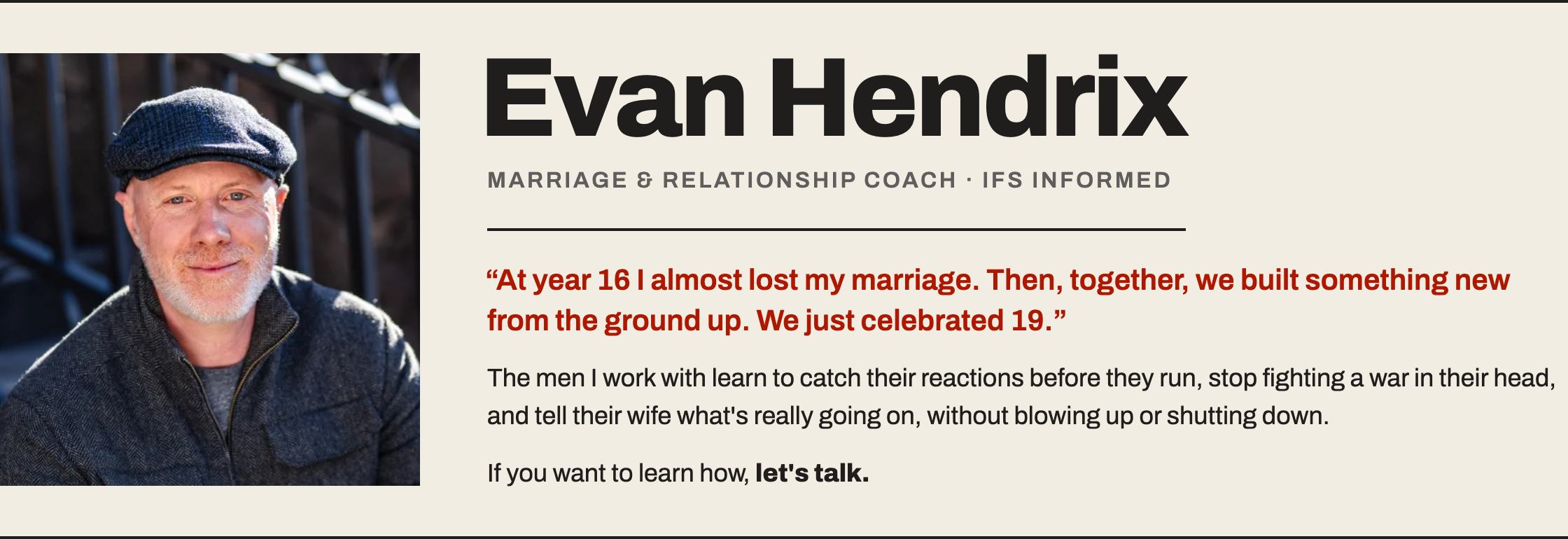
They start catching their behavior before it runs them, stop fighting a war in their head, and start telling their wife what's really going on, without blowing up or shutting down.
If you saw yourself in this, book a call. We'll talk about what's going on, what you actually want, and whether this work is the right next step.
Book a call → My Calendar